Skip to content
The library office will be closed 10/13 12:00 - 2:00 pm. Please plan to arrive after 2:00 pm. Thank you!
Learning Resources
Play

Why Do Unbelievers Reject the Solid Evidences for Christian Truth

Introduction

Evidential apologetics employs the principle that if the evidence for the faith is of the kind unbelievers themselves must employ to arrive at good decisions, they must either accept the truth of the gospel supported by parallel argumentation OR stop employing the same reasoning in their secular decision-making. Legal/juridical apologetics carries that same principle further: if the Christian message can be supported by arguments qualitatively the same as those normatively employed in courts of law, the unbeliever must recognize and accept the force of the Christian case OR jettison the legal system itself (an entirely nonsensical alternative). This lecture offers a trenchant illustration by way of the reasons clients irrationally reject the good advice of their own lawyers.
Discover more

1:27
Religion and Public Life
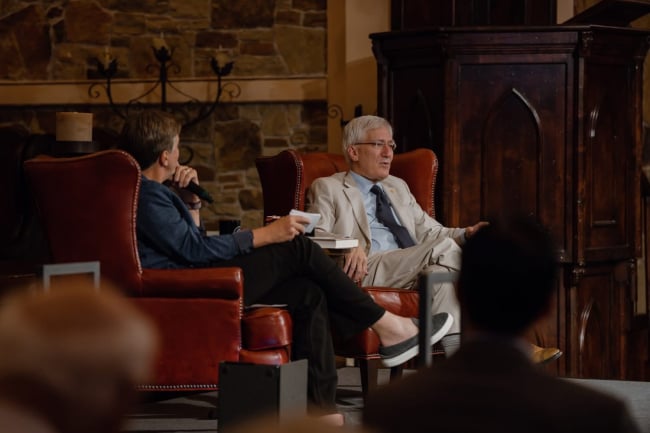
Ft. Robert George

Robert P. George, one of America’s leading scholars of law, ethics, and public life joins us. This engaging discussion will explore topics related to religion and public life, offering attendees a unique opportunity to hear Professor George’s insights in a dynamic conversational setting.

1:07
C. S. Lewis: His Significance For Personal Faith and the Ministry of the Church
Ft. Alister McGrath

C. S. Lewis is widely regarded as one of the most important and accessible Christian writers of recent year. In this lecture, Professor Alister McGrath of Oxford University will speak on how Lewis can help us consolidate and develop our personal faith and resource the preaching and outreach of churches. How can Lewis encourage us and help us to grow in our faith, or even explain our faith to friends and family? How can Lewis help preachers and apologists communicate and commend Christianity? There is growing interest in Lewis as a resource for personal faith development and church outreach. In this lecture, Professor McGrath will explain why and point to ways in which Lewis can enrich the life of faith.

1:10
Anti Christian Bias in the Academy and How To Fight It
Ft. George Yancy

American culture has shifted dramatically in the last decade toward stances which are openly hostile to the Christian faith. Views now aggressively promoted in popular and journalistic media, flourished decades earlier only in elite liberal arts faculties. We need an elite generation of Christian academics to feature in tomorrow’s universities, ensuring that a gospel-centered voice informs every conversation.

1:16
Reading the Bible the Right Way Up
Ft. N. T. Wright

Emanuel Tov explains that the Qumran scrolls were produced by highly trained scribes who followed consistent practices in layout, spelling, and correction, revealing an organized scribal culture rather than random copying. These scribal habits help scholars understand how biblical and non-biblical texts were transmitted and preserved in the Second Temple period.

1:22
1:10
Beloved But Known
Ft. Ben Witherington

Emanuel Tov explains that the Qumran scrolls were produced by highly trained scribes who followed consistent practices in layout, spelling, and correction, revealing an organized scribal culture rather than random copying. These scribal habits help scholars understand how biblical and non-biblical texts were transmitted and preserved in the Second Temple period.

Visiting us, to advance your theological study and explore your faith